Fixing subsidence
Paving Re-levelling In Amsterdam
Does rain sit against your wall after every downpour?
Sunken gardens, paths and driveways brought back up to level, usually with the stones already there
In Bijlmer-Oost the houses are assumed to stand on concrete piles. They stay where they are. The garden around them doesn't: it drops a few millimetres every year, until the paving by the back door forms a dip that fills with water after every shower. Paving re-levelling in Amsterdam means lifting the stones, putting fill sand (ophoogzand) underneath and relaying everything with a fall away from the house. Your own slabs or pavers can usually go back down. We measure the height differences first, for free, look at how your neighbours' gardens sit, and tell you straight if raising your garden isn't a sensible plan.
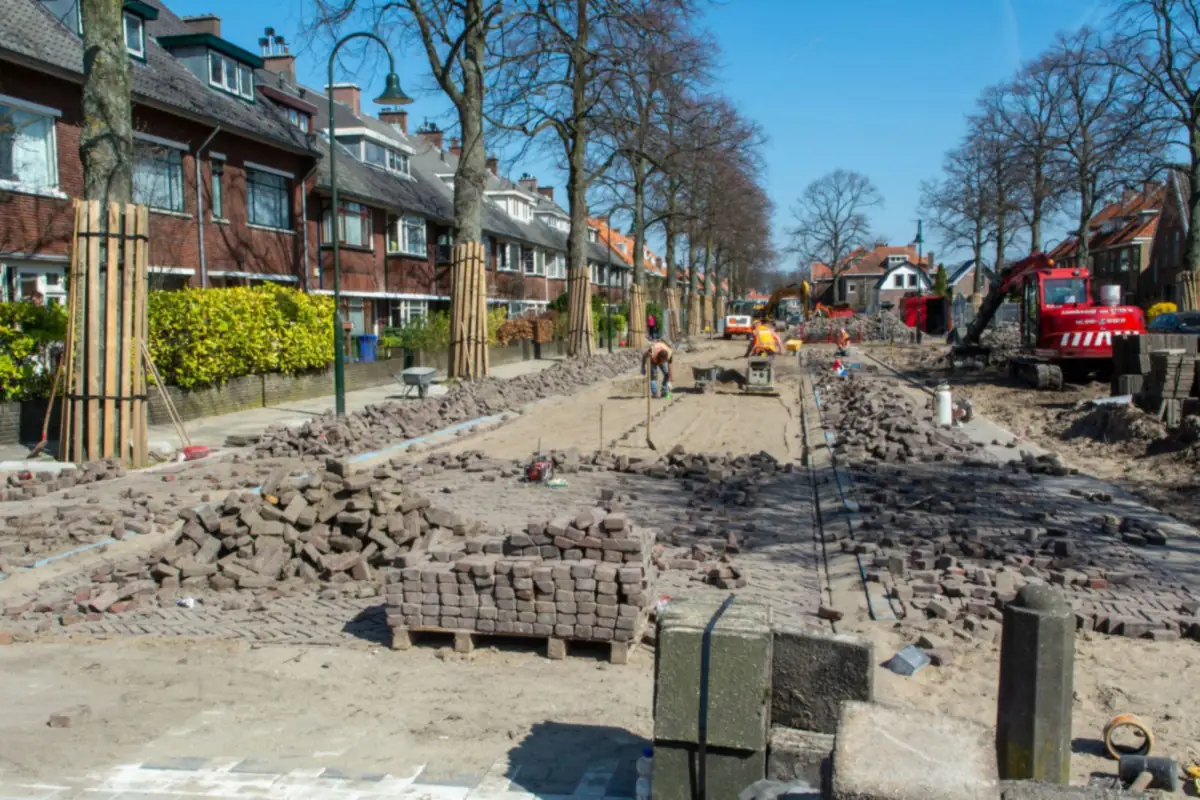
Get the height difference measured
- 1Send a photo of the spot where water collects
- 2We measure levels against your threshold and the neighbours
- 3You get a price, or honest advice that another route makes more sense
- Free site survey
- Fixed price in writing
- KLIC utility check done
- Foundation built to suit
- English & Nederlands
What re-levelling gets you
Why paving re-levelling in Amsterdam is more than tipping in sand
In 2022 Deltares, the Dutch water and subsoil research institute, studied how fast the ground is sinking in five pilot areas for the city. Around the Krulslaplantsoen in Bijlmer-Oost it came out at 1.7-6.3 mm a year. Run that over twenty years and you're looking at anything from 3 to over 12 centimetres.
Water off the wall again
After raising, the paving falls at least 1 cm per metre away from the house again. The water that now hangs around against the wall runs off to a spot we agree on together.
No bill for new stone
Whole slabs and pavers come up, get stacked and go back down later. What you pay for is mostly labour and sand.
No more step at the door
Paving should sit 1-2 cm below the door threshold. If that has turned into an 8 cm step over the years, we bring it back to that margin.
Sand that stays put
The fill sand goes in in thin layers and each layer gets the plate compactor. Your stones only go back once the whole lot is firm.
An eye on the boundary
Deltares found that in Amsterdam, flooding problems shift next door when one garden is raised and the neighbour's isn't. So the level of the garden beside yours is part of the plan.
Pipes in view
When the gap in level between house and garden gets too big, connections to the sewer and water main can crack, Deltares writes. If they're exposed when we lift the paving, we take a look and tell you if something doesn't look right.
1
point of contact from survey to handover
m²
quotes itemised per square metre
KLIC
cable and pipe check before we dig
€0
for the site survey and advice
How it works
How we bring your garden back up to level
Re-levelling looks a lot like re-paving, with one big difference. We fix the finished height first, and only then does a spade go into the ground.
- 01
Measuring levels
We measure the threshold, the current paving, the boundary and your neighbour's garden. Then you know how many centimetres need adding and where the water runs now.
- 02
Advice and quote
You get a price per m² for lifting and relaying, plus the volume of fill sand in cubic metres. If, in your case, there's more against raising than for it, our advice says so.
- 03
Neighbours, KLIC and lead check
If the work touches the boundary, have a word with the neighbours first. If a mini digger is needed, we file the KLIC notification (the national cable and pipe check) with the Kadaster. For older city gardens, you can ask the city for a loodcheck (soil lead test) before anyone digs.
- 04
Lifting and raising
Usable stones go on pallets, sorted by type. Then the fill sand goes in, compacted layer by layer, up to the new height minus the depth of the stone and its bedding layer.
- 05
Edging at the new height
Kerbs along paths and borders come out and go back in higher, 2 cm below the new paving surface.
- 06
Relaying with a fall
On a screeded bedding layer we relay your own stones, running down away from the wall. Broken ones are replaced with the closest match we can find.
- 07
Sweeping in and walking it through
The joints get filled with crushed-stone sand. We go over the new levels with you, including against next door, and take away whatever material is left.
- →
What next?
Start at step 1: a visit to measure up. Free, and you are not committing to anything.
Book a survey →
Commitments you can reread
What we promise is written down
Paving that starts to ripple after one winter is rarely a problem with the stones on top. The fault sits underneath: too little sand, a sub-base that was never compacted, or edging that gets pushed out the first time a car rolls over it. That is why our quote spells out more than the stone you are getting. It also states how deep the foundation goes, what we raise the level with and how the edges are held in place.
It also keeps any complaint simple. If part of the paving works loose or a strip sinks because of the way we laid it, we come back and put it right. Settlement caused by the ground itself is a different matter - peat under Amsterdam slowly compresses whatever anyone does - and we would rather tell you that up front. What we can do is build it so that raising the level later means lifting and relaying the stones, not starting again from scratch.
In writing
foundation, materials and edging are all in the quote
We return
if our workmanship is the cause, we fix it
Before you choose
Before you have your garden raised: three things to ask
Have the levels measured with a spirit level or laser, not guessed by eye. You're dealing with a handful of centimetres against the threshold, the boundary and the garden next door. Skip that step and the slabs might go back beautifully flat, with the water still running the wrong way.
The second point is the sand. Fill sand should be compacted in layers, not dumped in one go and smoothed off. Ask, too, where your downpipe drain and the house connections run. According to Deltares it's exactly those pipes that can crack when house and garden drift too far apart, so a contractor who sees a pipe under strain ought to mention it.
And finally, your old stones. Clay pavers and concrete slabs that are still whole can usually go back, and in an average back garden that saves a fair bit on materials. If they're broken or worn, choose new stone with a KOMO quality mark: for concrete, look for BRL 2312 on pavers or BRL 2313 on slabs.
Compared
Raise it, replace it, or rethink the garden
Raising isn't the only answer to a wet, sunken garden. Here are four routes side by side, with indicative prices from the Trustoo and Homedeal price guides.
| Raise with your own stones | New paving at height | Rain-ready garden | Do nothing | |
|---|---|---|---|---|
| What happens | Stones up, sand in, stones back | Old paving out, new base and stone | Level stays, rain gets a place in the garden | The garden keeps sinking |
| Guide price | €20-30/m² relaying, plus fill sand at €50-70/m³ | €45-115/m² incl. VAT, plus removal at €10-25/m² | Depends on the design | Nothing now, possible damage later |
| Water at the wall | Runs away from the house again | Runs away from the house again | Caught within the garden | Stays put |
| Effect on neighbours | Water may move to a lower garden next door | Same, unless you raise together | Water doesn't shift | No change |
| If sinking continues | Raise again after some years | Raise again after some years | Sinks with it, keeps working | Problem grows |
| Suits | Whole stones, garden easy to reach | Worn paving or a new design | Deep-lying garden, hard access | Minor sinking with no flooding |
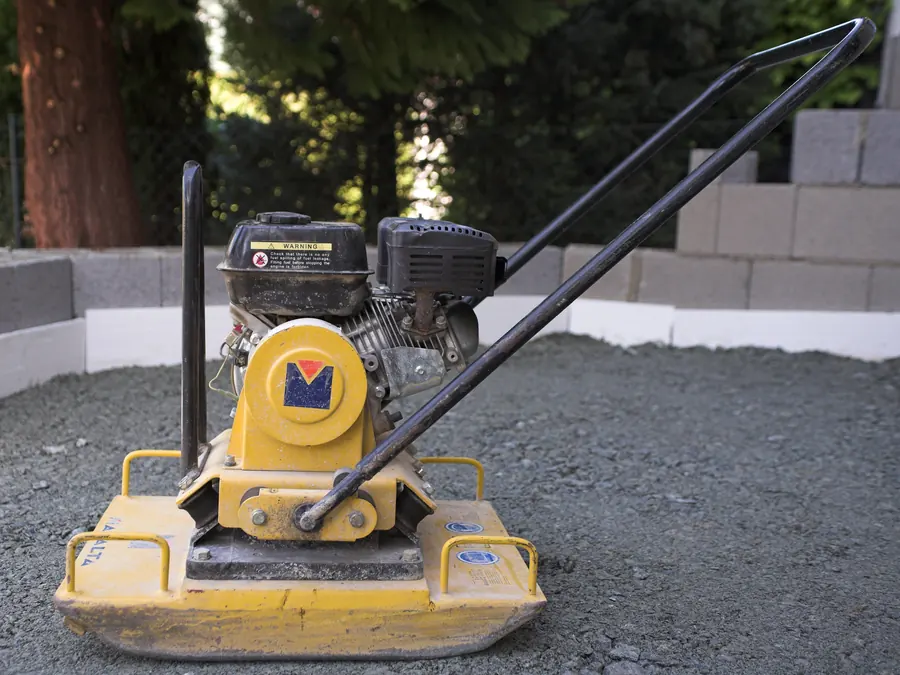
Fill sand and compactor
What goes back under your slabs
It's only when the paving is up that you see how far the garden has really dropped. We put the new sand in thin layers and compact each one, up to the height we set out at the survey. Only then does the bedding layer go on. Homedeal puts fill sand at €50-70 per cubic metre including VAT. Raising 30 m² of garden by 10 cm takes 3 cubic metres, so roughly €150-210 worth of sand.
- Fill sand compacted layer by layer, never dumped in one go
- New level set out with a string line from the threshold
- 1-2 cm margin below the door threshold
- A fall of at least 1 cm per metre, away from the house
"In the gardens we measure in Zuidoost, the biggest height difference is usually right along the wall. The house stays put on its piles, while the slabs a metre further out have simply gone down with the ground."
Cost
What paving re-levelling in Amsterdam costs
With re-levelling you pay for lifting and relaying the stones, for the sand that goes in, and sometimes for disposal or new material. Trustoo gives €20-30 per m² for relaying sunken paving. Homedeal puts fill sand at €50-70 per cubic metre including VAT. If soil or old paving has to go, the same guide charges €10-25 per m² for removal and the same again for digging out.
- €How many centimetres you need: every 10 cm over 10 m² is one cubic metre of fill sand.
- €Whether your stones can go back: reusing them saves the full material cost of new slabs or pavers.
- €How the sand gets into the garden: at a terraced house with no rear access it all goes through the house, and one garden in the Mercatorbuurt would have needed a crane to lift it over the roof.
- €How fast your area sinks: Deltares measured up to 6.3 mm a year around the Krulslaplantsoen and 2.5-3.5 mm in the Transvaalbuurt. Where it's quicker, we raise a little more, within the margin under your threshold.
- €A lead check for older gardens: request it from the city before any digging, so you know what's in the topsoil.
Guide price from
€20/m²
Guide price for relaying sunken paving according to Trustoo (2026). The source doesn't say whether VAT is included; labour carries 21%. Sand and disposal come on top. Your fixed price follows a free survey.
Ask for a fixed priceQuestions
Questions about paving re-levelling in Amsterdam
Do I need a permit to raise my garden?
Raising and relaying the paving in your own garden usually doesn't need a permit. It's different for a national monument (rijksmonument), a building in a protected townscape (beschermd stadsgezicht), or if anything changes about your exit onto the street. Check your address with the vergunningcheck (permit check) in the Omgevingsloket. Bear in mind the city only raises public space. Your own garden is your responsibility.
Why is my garden sinking when my house isn't?
In Zuidoost the houses are assumed to stand on concrete piles. Deltares describes how piled houses don't sink, but gardens, streets and unpiled pipes do. Tuindorp Oostzaan in Noord is the other way round: the houses there sit on shallow foundations (op staal) and go down with the ground.
How often will I need to raise it?
That depends on your area. Deltares estimates subsidence around the Krulslaplantsoen in Bijlmer-Oost at 1.7-6.3 mm a year; at that rate you lose 5 cm somewhere between 8 and 29 years. In Terrasdorp in Noord it's 1.1-2.3 mm a year, so it takes longer. Where the threshold allows, we raise a little extra.
Should I tell my neighbours?
We'd strongly recommend it. Deltares found in Amsterdam that flooding problems move next door when one resident raises their garden and the other doesn't. Raise together and the water doesn't end up sitting on the boundary, and you can share the sand delivery.
Can my own slabs go back down?
Usually, yes. Whole slabs and pavers are lifted and relaid on the new sand bed. Broken or worn ones get replaced. At the survey we check how many are reusable, so that's already in the quote.
When would you advise against raising?
When the garden sits so low that getting sand in is barely possible, or when all the planting would have to come out. Weerproof (formerly Amsterdam Rainproof) describes a back garden in the Mercatorbuurt about 50 cm below street level, with groundwater roughly 20 cm down. Raising it would have meant replacing every plant and lifting the sand over the roof by crane. The owner went for a garden that can cope with rain instead. Sometimes that's the better choice for you too, and if so, we'll say it.
Reviews
What our customers say
Judge us on paving that is already down.
We have only just started collecting reviews, and they will appear here as they come in. Until then, ask to see photos of recent work near you when we come out to measure up. A terrace two streets away says more than five stars.
Service area
Sunken gardens in and around Amsterdam
We raise gardens across Amsterdam, including the areas where Deltares measured subsidence: Bijlmer-Oost, the Transvaalbuurt, Tuindorp Oostzaan and Terrasdorp. Outside the city we work in Almere, Purmerend, Diemen and Amstelveen, among other places.
- Amsterdam-Zuidoost
- Amstelveen
- Diemen
- Duivendrecht
- Ouderkerk a/d Amstel
- Abcoude
- Weesp
- Almere
- Badhoevedorp
- Hoofddorp
- Zaandam
- Purmerend
Measure first, raise second
Send a photo of the spot where water collects. We'll come and take the levels, then tell you what raising would cost, or why something else makes more sense.