Patios against the house
Patios & Terraces In Amsterdam
Does rain run towards your back door instead of away from it?
Ceramic, concrete and natural stone patios, laid at the right height and fall, for gardens across Amsterdam
With patios and terraces in Amsterdam, nearly everything comes down to one line: the bottom of your back door. The patio should sit 1 to 2 centimetres below that threshold and fall away from the wall by 1 to 2 centimetres per metre. Get that right and a summer downpour stays outside. Get it wrong and water pools on the doorstep. After that comes the material, and each one needs the right base: a 2 centimetre ceramic tile asks for something quite different from a concrete slab. And because most Amsterdam back gardens are small, we'll also talk about how much of it really needs paving.
Book a free patio survey
- 1Send us your address and the material you have in mind
- 2We measure the garden and take your door threshold as the fixed point
- 3Within a few days you have a quote with build-up, fall and any planting strip, at a fixed rate per m²
- Free site survey
- Fixed price in writing
- KLIC utility check done
- Foundation built to suit
- English & Nederlands
What you'll notice
A patio in Amsterdam that suits your house
You won't spot the difference between a good patio and a mediocre one in June. You'll spot it in February after a week of freezing and thawing, and at the first cloudburst in August.
Dry feet at the back door
Excluton advises laying a patio 1 to 2 centimetres below the door threshold. We measure the threshold first and work down from there, not from the height of the old slabs.
Water going the right way
A fall of 1 to 2 centimetres per metre sends rain towards the garden or a channel drain. KNMI, the Dutch met office, records an average of 850 millimetres a year at Schiphol, with August the wettest month at almost 99 millimetres.
Joints that get through winter
Schiphol averages almost 43 frost days a year (KNMI, 1991-2020). Water sitting in a joint expands every time it freezes. A flat, well-draining base gives that water less of a chance.
Ceramic on a solid bed
A 2 centimetre ceramic tile can't go on loose sand. It needs a stabilised bed underneath, exactly as the supplier's laying instructions require.
Room for planting
Dutch guidance on permeable paving advises keeping at least 60% of a garden green. In a small back garden that isn't always possible, but a planted strip along the fence nearly always is.
A garden that sinks without you noticing
In Zuidoost the houses are assumed to stand on piles, while the garden around them settles. Deltares measured 1.7 to 6.3 millimetres a year around the Krulslaplantsoen. We lay patios so they can be raised later.
1
point of contact from survey to handover
m²
quotes itemised per square metre
KLIC
cable and pipe check before we dig
€0
for the site survey and advice
Order of work
How we lay patios and terraces in Amsterdam
The fixed point is your threshold. Every layer below it is worked out from that height, to the centimetre.
- 01
Visit and measure the threshold
We measure the garden, take the height of your back door as zero and look at where the water goes now. We also talk about whether you'd like to pave less, and whether Amsterdam's Subsidie Groen (its greening grant) could help.
- 02
A quote layer by layer
The quote lists the foundation depth, the sand or stabilised bed, the tile, the joint filling and the fall. If you're applying for the grant, we split labour, materials and VAT the way the city asks.
- 03
Setting out and KLIC
We mark heights and fall with string lines and pegs. If a machine is going to dig, we first file a KLIC notification with the Kadaster (€10.50), the legal cable check, at least 3 working days ahead.
- 04
Old slabs out, foundation in
We lift the old paving and dig out. An ordinary patio gets about 20 centimetres of build-up. For 2 centimetre ceramic that becomes about 15 centimetres of crushed recycled concrete (betongranulaat) with at least 10 centimetres of cement-stabilised sharp sand on top.
- 05
Edging the patio
Along the patio edge we set edging kerbs of at least 5 x 15 x 100 centimetres, 2 centimetres below the tile surface. Where the patio meets the planting strip, they keep soil and tiles apart.
- 06
Laying to a fall
We lay from the wall outwards, building the fall in from the first row. A 2 centimetre ceramic tile gets a bonding layer on its back before it goes onto the bed.
- 07
Jointing and a final check together
Ceramic tiles get joints at least 3 millimetres wide and 30 millimetres deep. Then we empty a bucket of water by the back door together and you watch where it goes.
- →
What next?
Start at step 1: a visit to measure up. Free, and you are not committing to anything.
Book a survey →
Commitments you can reread
What we promise is written down
Paving that starts to ripple after one winter is rarely a problem with the stones on top. The fault sits underneath: too little sand, a sub-base that was never compacted, or edging that gets pushed out the first time a car rolls over it. That is why our quote spells out more than the stone you are getting. It also states how deep the foundation goes, what we raise the level with and how the edges are held in place.
It also keeps any complaint simple. If part of the paving works loose or a strip sinks because of the way we laid it, we come back and put it right. Settlement caused by the ground itself is a different matter - peat under Amsterdam slowly compresses whatever anyone does - and we would rather tell you that up front. What we can do is build it so that raising the level later means lifting and relaying the stones, not starting again from scratch.
In writing
foundation, materials and edging are all in the quote
We return
if our workmanship is the cause, we fix it
Before you choose
Three questions to ask before anyone lays patios and terraces in Amsterdam
The most important measurement happens at the back wall. Anyone quoting for a patio without measuring the threshold is guessing at the thickness of everything underneath. In older parts of Amsterdam the garden sometimes already sits below the street. Amsterdam Weerproof (formerly Rainproof) describes a garden in the Mercatorbuurt that lay about 50 centimetres below street level, with groundwater just 20 centimetres under the surface. You build a patio differently there than on dry sandy ground, and you only know that once someone has looked.
Ask what base goes under your particular tile, because it changes with the material. For 2 centimetre ceramic, Gardenlux specifies about 15 centimetres of betongranulaat, topped with at least 10 centimetres of sharp sand stabilised with cement at 25 kilos per 5 m². A 3 centimetre or composite tile can go on a sand bed of at least 10 centimetres. For a concrete or clay patio, Excluton gives about 20 centimetres of foundation including the bedding layer.
Finally, look at the tile and the joint. Concrete slabs with a KOMO mark meet NEN-EN 1339 and BRL 2313. With ceramic, the joint is where things go wrong: Gardenlux asks for at least 3 millimetres wide and 30 millimetres deep. A contractor who butts ceramic tiles tight together because it looks neat is setting you up for tiles that work loose after a few winters.
Compared
Patio materials in Amsterdam compared
Three materials turn up in almost every Amsterdam garden. The fourth option is paving less. Figures are indicative material prices from Homedeal (incl. VAT), without labour.
| Ceramic tiles | Concrete slabs | Natural stone | Smaller patio + planting | |
|---|---|---|---|---|
| Indicative material price | €25-70/m² | €15-35/m² | €40-70/m² | Fewer m² of tiles, grant possible |
| Base | Stabilised bed at 2 cm, sand bed at 3 cm | Sand bed, approx. 20 cm build-up | Depends on thickness and size | Planting strip with good soil |
| Permit for your own garden | Usually not needed | Usually not needed | Usually not needed | Not needed, but apply for the grant first |
| Joints | Min. 3 mm wide, 30 mm deep | Min. 2 mm, sand-filled | Depends on the stone | Fewer joints to maintain |
| Rainwater | Runs off via the fall | Runs off via the fall | Runs off via the fall | Soaks into the planting strip |
| Lifespan | Decades if the base is right | Decades, surface weathers | Decades, varies by type | Planting needs yearly care |
Ceramic up close
Ceramic tiles for your patio in Amsterdam
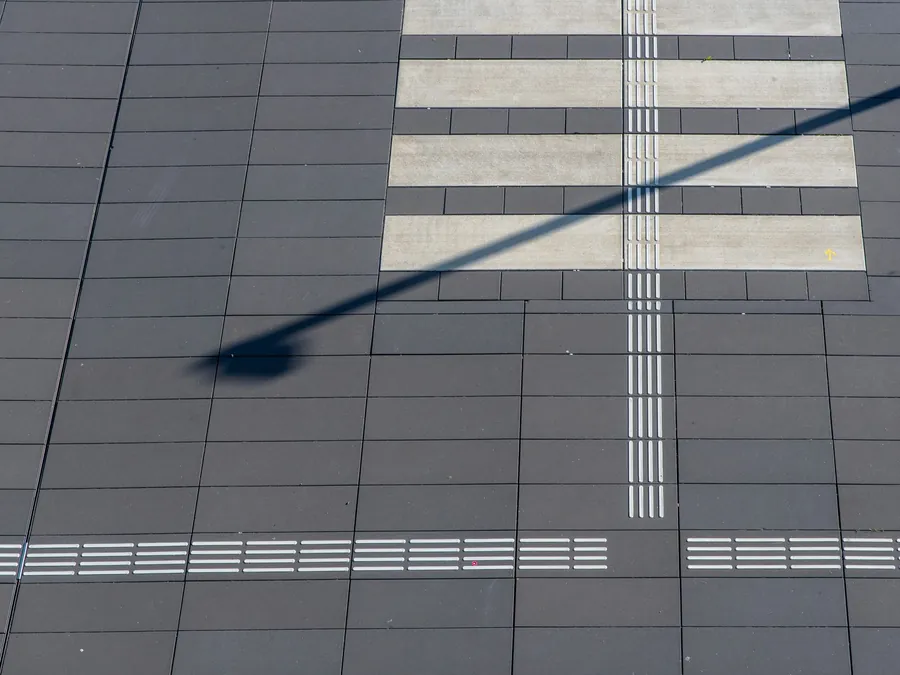
Ceramic looks crisp in a small city garden. It's also the material where workmanship matters most. The tile is thin and hard, so any unevenness in the bed shows up as a tile that clicks or rocks underfoot.
- 2 cm tiles on betongranulaat, with a stabilised bed and a bonding layer
- 3 cm tiles on a sand bed of at least 10 cm
- Joints at least 3 mm wide and 30 mm deep
- A bonding layer on every 2 cm tile, not just the edge rows
"In many of the Amsterdam back gardens we measure, the existing patio sits too close to the threshold or slopes slightly towards the house. Usually that's because someone once laid a new layer of slabs on top of the old one."
Cost
What do patios and terraces in Amsterdam cost?
Homedeal puts a complete patio at a minimum of about €70 per m², including VAT, materials and labour. Labour alone it estimates at €20 to €40 per m². After that, the material makes the biggest difference: concrete slabs are cheapest, while ceramic and natural stone run up to €70 per m² for the tile alone. On a small patio the fixed jobs, like taking away old slabs and building the base, weigh more heavily per square metre. You'll get a fixed price after the free survey.
- €Tile choice: Homedeal gives €15-35/m² for concrete slabs, €25-70 for ceramic and €40-70 for natural stone, materials only
- €Base for ceramic: betongranulaat plus cement-stabilised sand costs more than a plain sand bed
- €Height: in Bijlmer-Oost and around the Krulslaplantsoen the garden has often sunk relative to the house, so sand has to go in first to get back up to the threshold
- €Access: with a mid-terrace house everything goes through the house or down a narrow back passage, and that takes hours
- €Paving less: swap at least 10 m² of tiles for planting and the Subsidie Groen can pay back up to €15/m²
Guide price from
€70/m²
A rough, indicative figure including VAT (21% on labour), taken from Dutch price guides. What you actually pay is set once we've measured up for free.
Ask for a fixed priceQuestions
Questions about patios and terraces in Amsterdam
Do I need a permit to pave my back garden?
Usually not. We haven't found any Amsterdam rule that limits paving in your own garden. The city's rainwater storage rules apply to buildings, not garden paving. If your home is a listed monument or in a protected townscape (beschermd stadsgezicht), or you're planning more than paving, use the vergunningcheck (permit checker) on the Omgevingsloket website.
How high should the patio be compared with the back door?
Excluton advises 1 to 2 centimetres below the threshold. Lower is fine, higher isn't: in a heavy shower water will run over the step and inside. From the wall outwards we give the patio a fall of 1 to 2 centimetres per metre.
Can ceramic tiles go on an ordinary sand bed?
It depends on the thickness. 3 centimetre tiles and composite tiles can go on a sand bed of at least 10 centimetres. For 2 centimetre ceramic, Gardenlux specifies about 15 centimetres of betongranulaat with at least 10 centimetres of cement-stabilised sharp sand, plus a bonding layer on the back of each tile.
What does frost do to a patio?
KNMI counts almost 43 frost days a year on average at Schiphol, and the ground freezes at 10 centimetres depth on about 65 days a year. Water in a joint expands as it freezes and pushes the jointing out. A proper fall and well-filled joints keep that in check.
Can I get a grant if I make my patio smaller?
Possibly. Amsterdam's Subsidie Groen pays up to €15 per m², to a maximum of €1,000 per house with its own garden, if you replace at least 10 m² of tiles with planting and keep it that way for 5 years. You must apply and be approved before work starts. We write the quote in the format the city asks for.
How much of my garden should I pave?
The Dutch guidance sheet on permeable paving, produced with RIONED, STOWA and the Ministry of Infrastructure and Water Management, advises keeping at least 60% of a garden green. With a patio against the house in a small Amsterdam garden, that's hard. A planted strip along the fence and a slightly smaller patio often get close.
Reviews
What our customers say
Judge us on paving that is already down.
We have only just started collecting reviews, and they will appear here as they come in. Until then, ask to see photos of recent work near you when we come out to measure up. A terrace two streets away says more than five stars.
Related
Other work in Amsterdam
Service area
Patios across Amsterdam and the region
We lay patios in the back gardens of the renewed Bijlmer and Gaasperdam, in Watergraafsmeer and the Westelijke Tuinsteden, and in Tuindorp Oostzaan in Noord. Outside the city we work in Diemen, Amstelveen, Weesp and Purmerend, among other places.
- Amsterdam-Zuidoost
- Amstelveen
- Diemen
- Duivendrecht
- Ouderkerk a/d Amstel
- Abcoude
- Weesp
- Almere
- Badhoevedorp
- Hoofddorp
- Zaandam
- Purmerend
Start at the back door
Book a free survey. We measure your threshold, see where the water goes now and work out a fixed rate per m², with a smaller patio and more planting if that suits you better.